
佩小姐的奇幻城堡
23 humanoid robot teams compete in rescue missions at 2nd WHRG, facing real-world complexity beyond dancing in coordination_我的网站

A |
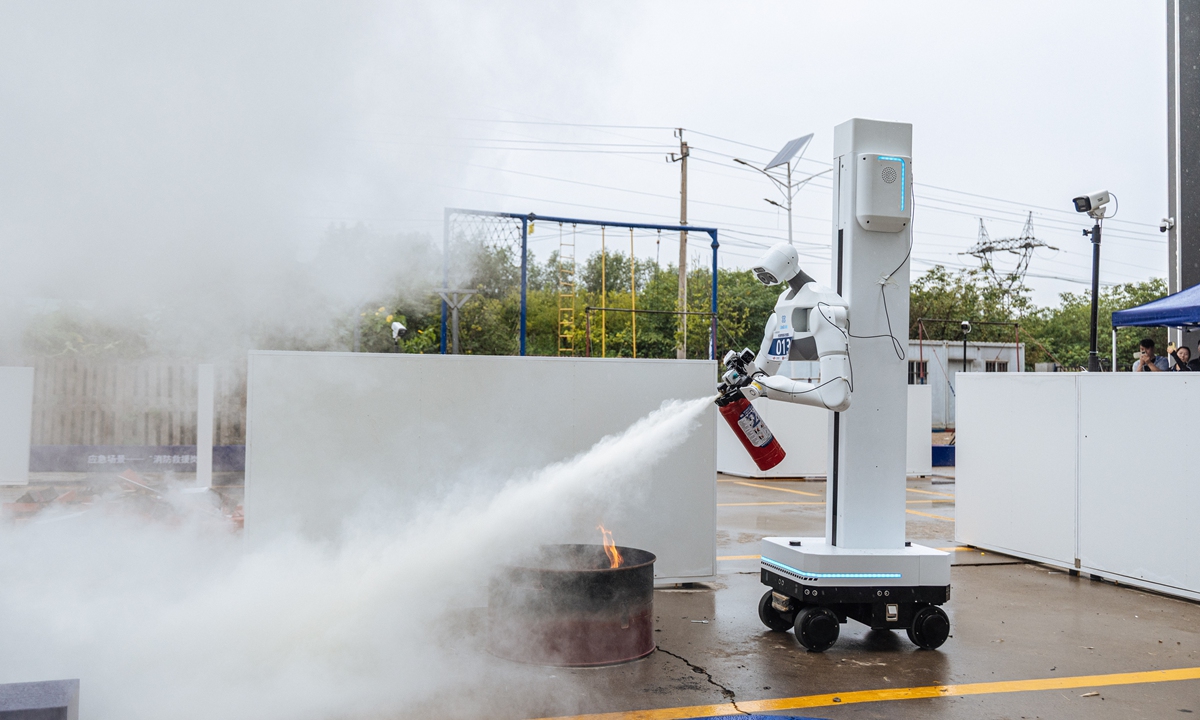
The firefighting final of the emergency management category at the 2nd World Humanoid Robot Games (WHRG) was held on Sunday in Beijing, putting 23 teams through a simulated rescue operation designed to test whether humanoid robots can move beyond demonstrations and perform practical tasks in complex real-world environments.
The event comes as Chinese humanoid robots, long known for eye-catching abilities such as running, dancing and music playing, are pushed toward practical applications, including jobs that are dangerous for humans such as emergency rescue.
Unlike the first edition of the WHRG last year, according to the organization committee, this year's scenario-based events emphasize "realistic simulation," with the firefighting competition being held at a fire brigade rather than in a model-room setup.
The competition simulated a firefighting assignment that required each of the 23 robots to complete three tasks within 30 minutes: identify hazardous materials, shut off valves and operate a fire extinguisher. For the first task, robots had to identify two randomly placed simulated hazardous substances and report their types to judges through returned images. They then had to locate three randomly selected open valves of different types and shut them off before identifying a fire source, finding a fire extinguisher and spraying it until the fire was put out.
Human firefighters were also involved in the event, lighting the fire and observing whether the robots carried out the extinguisher operation correctly.
The competition, however, showed how difficult it remains for robots to perform reliably outside controlled laboratory conditions.
Rain affected the competition, while changes in lighting and the outdoor environments added uncertainty to the robots' visual recognition and manipulation tasks. A team from UniX AI, a company well-known for its robot applications on real-world scenarios and has just raised a new round of 300 million yuan ($ 44.49 million) in late March, completed its run within the allotted time, but its robot moved relatively slowly compared to human firefighters' real practice. When operating the fire extinguisher, its robotic hand had to make two attempts to align with the target.
Of 12 teams competed on Sunday, three finished the challenge.
Yang Liqi, a representative of the UniX AI team, told the Global Times that the firefighting scenario placed higher demands on both the robot's recognition and manipulation capabilities.
"Rain and lighting conditions can affect the robot, and actual situations are often different from what we simulate in the laboratory," Yang said, noting that this was also one reason why a number of teams were unable to complete their runs on Sunday morning.
The team had programmed the robot to make up to three attempts when operating the extinguisher. "If it sees white smoke after the first attempt, it will not make a second attempt," Yang said.
The difficulty was not simply that whether the robot could move its arm. Humanoid robots rely on different types of joints for different tasks: small, high-precision joints enable delicate hand operations, while high-torque, reliable joints support movement and balance.
A failure at any point of actions and detection could affect the final result. This is precisely where the value of real-world competitions lies, Jin Chenran, a representative of the Tiangong team whose robot only accomplished one of the three tasks, told the Global Times.
"Whether the competition goes smoothly or not, that is the significance of a real-world simulation. Every real-world failure is valuable data that helps humanoid robots toward practical application," Jin said.
Jin further explained that questions like why the robot failed to recognize an object and how its motion-planning system selected the wrong path... Such data can subsequently be used to improve algorithms and train AI models.
The competition also offered a glimpse into the current transitional stage of humanoid robot technology. At the venue, some team members were wearing VR headsets and remotely adjusting their robots shortly before their runs.
Some humanoid robots were seen using omnidirectional wheels instead of feet, while their hands featured multiple joints to enable more precise manipulation. Many teams chose China-developed UBTECH's joint modules for their robots. Its servo actuators cover a wide torque range from 0.2Nm to 200Nm, allowing robots to combine dexterity with strength. Meanwhile, VR teleoperation gives operators a first-person view through the robot's cameras, enabling them to remotely guide movements in real time.
The event comes amid a broader push in China to move humanoid robots and embodied intelligence from laboratories and competition arenas into real production and daily-life environments. In June, the Ministry of Industry and Information Technology and the other departments launched a special program for humanoid robots and embodied intelligence that encouraged applications in practical fields including emergency rescue.
Zhao Weidong, deputy director of the organizing committee office, told the Global Times that the scenario-based competitions are intended to test the progress of humanoid robots from "competition performance" toward "real operational work," including whether they can eventually become intelligent partners for firefighters.
"At present, many simulations of actual operations may still be at an early stage," Zhao said. "But these are an important starting point for enabling robots to truly assist humans in real-world environments, as well as an important source of data and testing."
The ultimate goal, Zhao said, is to push robots into fields where human operations are dangerous and achieve genuine "human-robot complementarity."
。 中新社北京8月21日电 记者21日从中国电力企业联合会获悉,7月全国全社会用电量规模再创历史新高。有关电力专家指出,第三产业用电量增速较快,高技术及装备制造业用电量表现突出,新动能用电保持高速增长,新质生产力对用电的支撑作用持续强化。 7月,全国全社会用电量1.04万亿千瓦时,月度用电量规模再次突破万亿千瓦时,同比增长1.7%;7月用电规模比上年同期多174.5亿千瓦时,再创月度用电量历史新高。 中国电力企业联合会统计与数智部主任助理吴立强表示,7月,第三产业用电量同比增长4.8%,增速为各产业中最快。同期,高技术及装备制造业用电量表现突出。高技术及装备制造业用电量同比增长8.9%,较上年同期提高1.7个百分点,对第二产业用电增量贡献率达55.8%。其中,电气机械和器材制造业与计算机/通信和其他电子设备制造业两个行业,对7月全国全社会用电量增量贡献率合计达33%。

B | 7月,消费品制造业用电量同比增长4.3%,占全社会用电增量占比14.4%,是制造业中除高技术装备外的第二大正向拉动板块。 吴立强说,在数字经济与交通电气化的双轮驱动下,7月,全国充换电服务业用电量164.2亿千瓦时、同比增长50.3%;互联网数据服务用电量99.1亿千瓦时、同比增长40.1%;信息传输、软件和信息技术服务业用电量210.3亿千瓦时、同比增长15.8%。7月当月,互联网数据服务和充换电服务业用电量增量合计超过第三产业用电增量比重的80%。 吴立强表示,受去年同期华北黄淮区域极端高温导致的居民生活用电增速高基数影响,今年7月城乡居民生活用电增速较上年同期下降23.1个百分点,对全社会用电量增量带来较大拖累。
Current article:http://7v0.ruidunguizanpaorangchongouxia.sbs/9qno/clpmx9.html
Published on:09:47:19
 泰国春节旅游被大量退单,有人不想承担7万元退订费决定继续行程
 国产游戏出海爆火!《白银之城》全球预注册突破千万
 东阳光集团电子新材料·秦淮数据重点项目集中开工投产仪式举行
 AI助盲眼镜产业化提速 政策加持企业布局
 2059家!福建省2026年第三批拟入库科技型中小企业名单公示
 中报关注度持续升温,机构建议配置三条业绩主线
我的网站最新内容
- ·市委常委会2026年调研成果交流会召开 刘强主持 于海田孙开连出席
- ·妊娠発表から2カ月〝今限定デニム〟マタニティコーデの藤田ニコルに驚き「どうやって履いて…?」「あっという間に大きくなっている!!」
- ·东山精密:公司具备硅光CW激光芯片研发能力
- ·减少铝材依赖 保时捷柏林之声400W低音炮将用上氮化镓
- ·Manhunt launched for Nashville police chief's son suspected in shooting of 2 Tennessee officers
- ·MIT的cMaSK技术将评估口罩对个人用户的适合程度
- ·政声直达丨上半年河北社会物流总费用与GDP比率为13.7%
- ·多部门联合开展法治进校园活动
- ·容声冰箱:从每一口新鲜出发 守护人宠更长久的陪伴
- ·已确认!当场击毙!
- ·'사무직 노조 탈퇴 늘어'…SK하닉, 성과급 놓고 '미묘한 긴장감'
- ·大乐透第26080期开10注一等奖
- ·无数第一次! 回顾国庆庆典精彩瞬间
- ·马斯克预告:首批搭载英伟达芯片的AI卫星明年Q4发射!
- ·开源,浙产大模型向世界敞开大门
- ·悦达起亚5月销量达22075辆 同比增长15.7%
我的网站热点内容
- ·四冠射手克莱-汤普森与独行侠达成买断 加盟热火
- ·主打以旧换新!2025车市第一波价格战来了
- ·【仓单】8月26日上期所沪铜期货仓单较上一日下降4028吨
- ·港股午评:恒生指数跌2.09%,恒生科技指数跌3.84%
- ·Japanese PM sends ritual offering to notorious Yasukuni Shrine
- ·蓝思科技:公司在AI眼镜领域已实现核心卡位
- ·天禾股份:2026年4月至6月公司计提资产减值准备4358.24万元
- ·Teams increase 138% as World Humanoid Robot Games expands scale and influence
- ·博伦智汇宣布完成千万级天使轮融资
- ·时评 | 把产业优势转化为县域消费优势
- ·英镑兑美元短线下挫,日内跌超1%
- ·平台数智赋能 泉州专利转化跑出“加速度”
- ·曾创吉尼斯纪录!百斤大西瓜上市 快递小哥直接用上爬楼机送货
- ·国乒的集团优势正在瓦解,暴露出的问题待解答
- ·2026融资融券利率多少?两融利息计算、市场行情与下调方法
- ·数智技术赋能河北数字经济高质量发展学术交流会在石家庄举行